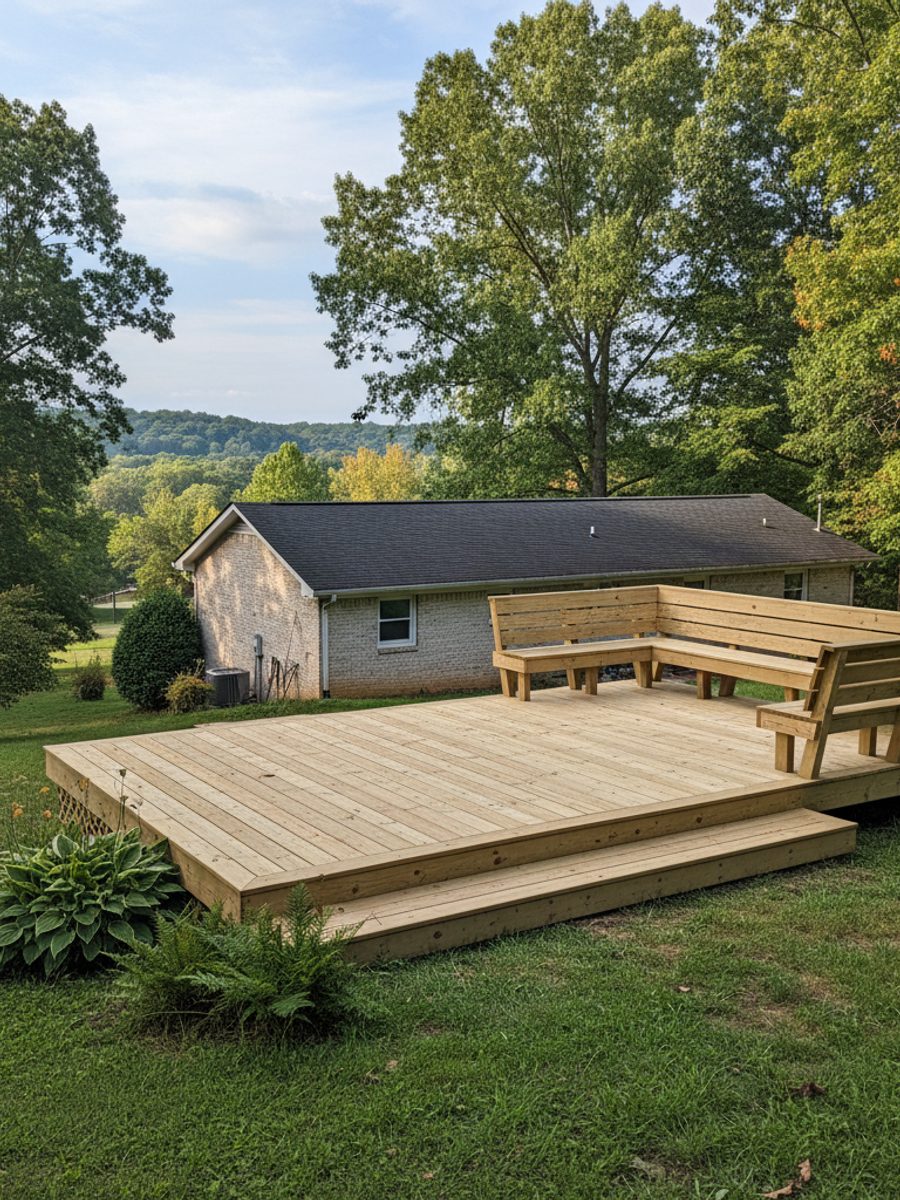
People ask us this a lot, usually in April when the dogwoods are blooming and they've decided this is the year. Spring isn't wrong, but it's not the whole answer either. The right time depends on what part of the job you're asking about, because a footing, a stain job, and a composite board install all have different enemies.
Here's how we actually think about the calendar in Bartlett.
Footings go in better when the ground isn't saturated
Most decks here sit on concrete footings poured below the frost line, which in Shelby County runs around 12 inches. That's shallow compared to what you'd see up north, but it still matters. A footing poured too shallow, or poured into wet, loose soil, can shift a few years down the road and you'll feel it as a soft spot or a board that's started to bounce.
The soil around Bartlett is mostly loess, a fine windblown silt, sitting over a clay subsoil. Loess handles water badly. When it's saturated it gets soupy and loses bearing capacity, which is exactly when you don't want to be setting posts. Late winter and early spring, January through April, tend to be our wettest stretch, and a hole dug the day after a heavy rain can cave in on itself before the concrete truck shows up. Late summer and fall, once the ground has had a chance to dry out, usually give us firmer digging conditions and a cleaner pour.
Concrete itself cures faster in heat, which sounds good until you remember that fast isn't the same as strong. A footing poured on a 95 degree July day needs to be kept damp or it can cure too quickly near the surface and crack. A footing poured in October, with daytime highs in the 60s and 70s, cures slower and more evenly, and that's the stretch we try to steer people toward for new builds and rebuilds.
Humidity controls when you can stain or seal
This is the one homeowners get wrong most often. You cannot stain a deck the week it's built. Pressure-treated lumber comes from the mill still wet, sometimes well over 20 percent moisture content, and stain won't bond to wet wood. It'll look fine for a season and then peel off in sheets. We generally wait 4 to 8 weeks after installation before staining new PT lumber, longer if it's been a rainy stretch.
Then there's Memphis-area humidity itself, which sits high most of the summer. Stain needs the wood dry on the surface and ideally no rain in the forecast for 24 to 48 hours after application. June through August, we're watching afternoon thunderstorms roll in off the river almost daily, which makes it hard to get a clean window. Late September and October tend to give us drier air and more predictable days, which is why that's our busiest stretch for staining and sealing, not building.
Summer heat changes how composite and PVC decking behaves
If you're going composite instead of wood, the calendar shifts again. Composite boards expand and contract with temperature more than people expect, sometimes close to a quarter inch over the length of a 20-foot board between a cold January morning and a 95 degree July afternoon. We leave gapping at the ends and between boards to account for that, and the spacing we use in December is not the same as what we'd use installing the same product in July. Get it wrong and you'll see buckling at the seams by the second summer.
Working conditions matter too. A crew on a composite deck in August is dealing with surface temperatures on dark-colored boards that can get hot enough to be uncomfortable to kneel on by noon. We start early and work around the heat of the day. It slows a build down a little, which is one more reason spring and fall jobs tend to move faster start to finish.
Permits and inspections run on their own clock
Bartlett requires a permit for most new deck construction, and that typically means a footing inspection before you pour and a framing inspection before boards go down. If your lot backs up to a drainage easement, which is common in some of the older sections off Stage Road and Yale Road, the inspector will also want to see that you haven't built over it. Newer subdivisions further out toward Arlington and Lakeland often have an HOA on top of the city permit, with its own setback and material rules, so it's worth checking that before you order lumber.
Spring is permit season here. Everyone has the same idea at once, and inspection scheduling can back up a week or two in April and May. Pull a permit in late fall or winter instead and you'll usually get your inspector out faster, even if the ground is a little colder to work in.
So when should you actually book the work
If we had to pick two windows for Bartlett: late September through November for building, because the ground has dried out, the air is dry enough to let concrete cure right, and permit offices aren't backed up. And late spring through early summer, May into June, for staining an older deck, once the worst of the spring rain has passed but before the daily thunderstorms settle in for the summer.
Winter isn't off the table either. We'll pour footings in January if there's no freeze expected and the ground isn't frozen solid, which around here is most winters. What we won't do is stain a deck in February and promise you it'll hold, or set posts the day after three inches of rain. If you want to talk through timing for your specific project, Bartlett Deck Co is a good place to start that conversation before you pick a date.